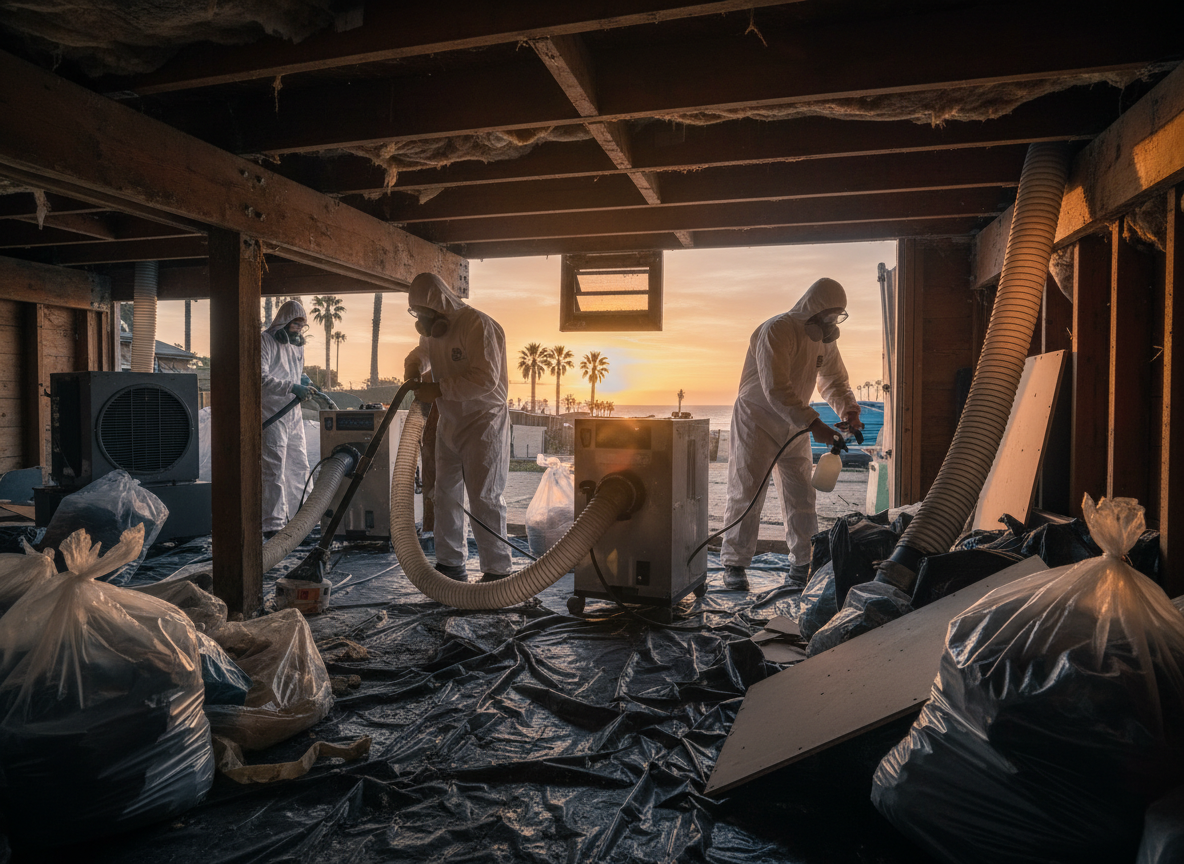
Sunset Beach homes built before the 1970s often feature plaster walls and crawl spaces that trap moisture after roof leaks or storm surge. Once drywall or insulation stays wet beyond 48 hours, mold colonies establish quickly in the mild coastal Mediterranean climate where summer fog keeps relative humidity elevated even when temperatures stay moderate. Technicians must cut back affected materials at least 18 inches beyond visible growth and use negative air machines to prevent spores from migrating into adjacent rooms near Pacific Coast Highway.
Seal Beach and Huntington Beach properties share similar soil conditions with high water tables, so slab leaks frequently push moisture upward into subfloors. Remediation crews test moisture levels in concrete and joists with penetrating meters before applying antimicrobial agents rated for marine environments. Failure to address hidden pockets behind baseboards or in HVAC ducts allows colonies to return within weeks, especially when cool summer evenings reduce evaporation rates.
Local building codes in Orange County require permits for structural drying that exceeds 100 square feet of affected material. Crews document every step with photos and moisture logs to satisfy insurance adjusters who routinely inspect properties along the coast. Homeowners who attempt DIY bleach cleaning often miss root growth inside wall cavities, leading to recurring odors and health complaints during the shoulder seasons when windows stay closed.
Technician insight
In Sunset Beach the thing that catches most people out with mold remediation after water damage is how quickly salt air and summer fog keep plaster and lath walls from drying on their own, especially in homes built before 1960 along Pacific Coast Highway where crawl spaces sit close to the water table.
Hidden Mold Behind Bathroom Wall
A Sunset Beach homeowner noticed musty odors after a slow shower leak. Inspection revealed mold behind original plaster in a 1950s cottage near the beach. Crews removed the affected section, treated the studs, and dried the cavity while protecting the rest of the home. Clearance testing allowed safe reconstruction within a week.
Mold Remediation After Water Damage Services We Offer
✓Crawl Space Mold Remediation
Remove mold colonies from pier-and-beam foundations common in Sunset Beach homes after plumbing leaks or tidal flooding, followed by vapor barrier installation.
✓Drywall and Insulation Removal
Cut and dispose of water-damaged drywall and insulation while maintaining containment to protect nearby living spaces in older beach cottages.
✓Attic Mold Treatment After Roof Leaks
Treat mold growth in attics caused by coastal wind-driven rain, including rafter cleaning and ventilation improvements to reduce future moisture buildup.
✓HVAC Duct Mold Cleaning
Clean and sanitize ductwork contaminated by mold spores that spread from water-damaged areas in Sunset Beach homes with central air systems.
✓Subfloor Mold Remediation
Address mold beneath flooring in homes near the beach where high water tables allow moisture to wick through concrete slabs after heavy winter rains.
Mold Remediation After Water Damage Cost in SUNSET BEACH, CA
| Service | Typical Range | What Affects It |
|---|---|---|
| Initial Assessment and Moisture Mapping | $250–$450 | Varies with home size and number of affected rooms |
| Crawl Space Mold Remediation | $1,800–$3,500 | Higher when vapor barrier replacement or insulation removal is needed |
| Drywall and Insulation Removal | $800–$2,200 | Depends on linear feet of wall and disposal fees |
| Attic Mold Treatment | $1,200–$2,800 | Increases with difficult access or rafter cleaning |
Ranges are typical for SUNSET BEACH, CA and confirmed with an exact written quote before any work starts.
How it works
- 1
Moisture Mapping and Containment
Technicians use meters to locate all wet materials and set up plastic barriers with negative air to isolate the work zone from the rest of the Sunset Beach home.
- 2
Material Removal
Cut away and bag affected drywall, insulation, and carpet padding, taking care to protect original plaster details found in many pre-war coastal properties.
- 3
Antimicrobial Application and Drying
Apply EPA-registered treatments to studs and joists, then deploy commercial dehumidifiers and air movers sized for the mild local climate until moisture readings normalize.
- 4
Final Clearance Testing
Independent air sampling confirms spore counts match outdoor levels before reconstruction begins, satisfying both homeowners and insurance carriers.
Pricing
Costs depend on square footage affected, material types, and whether hidden growth requires additional demolition in older homes.