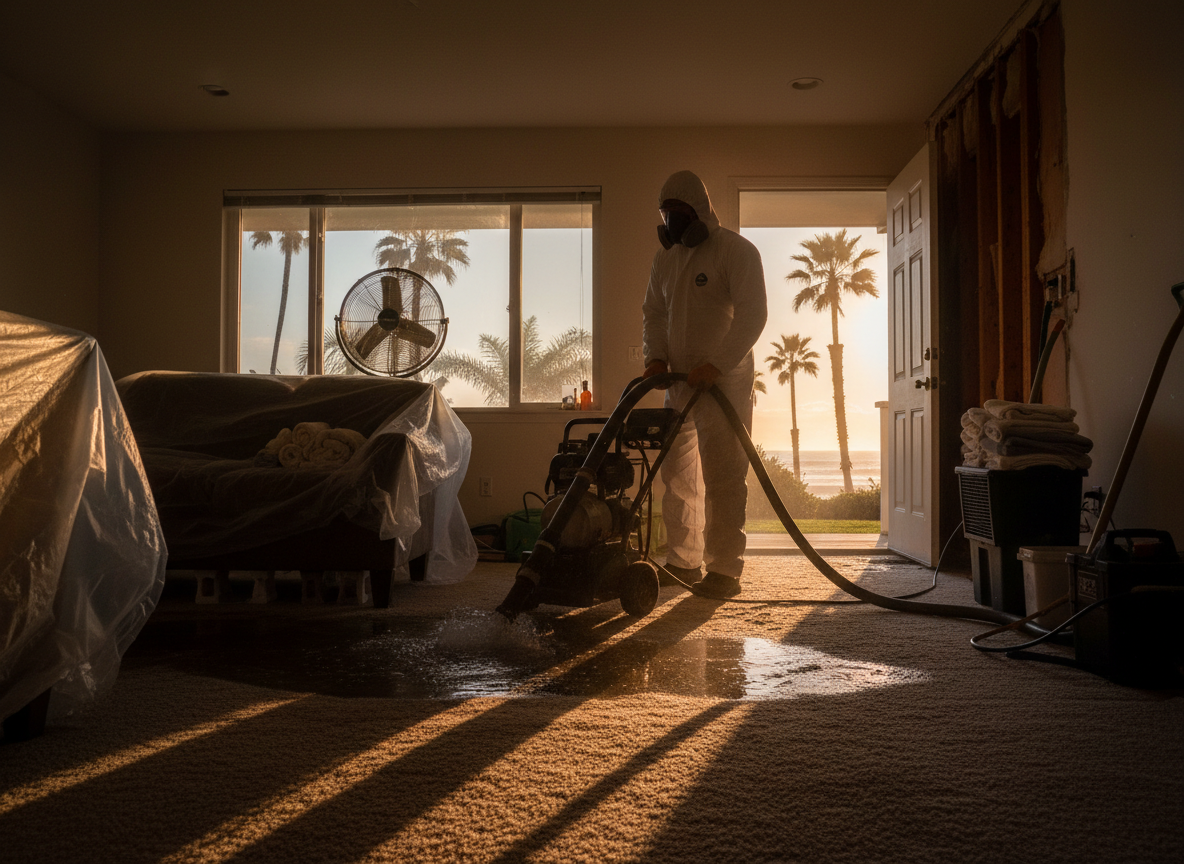
Sunset Beach homes sit on narrow lots close to the sand, many built before modern flood codes, so water from storm surges or pipe failures travels quickly under raised foundations and into crawl spaces. Mitigation starts with stopping the source, then rapid extraction to prevent salt-laden moisture from corroding framing and wiring. Because the area experiences mild coastal Mediterranean summers with persistent marine layers, humidity stays high enough that standard fans alone fail to pull moisture from plaster and hardwood; industrial dehumidifiers sized for the square footage are required to reach safe drying levels before mold sets in.
Technicians map moisture with infrared cameras and pin meters because water often hides behind bathroom tile or under kitchen cabinets in these older bungalows. In neighborhoods bordering Seal Beach and Huntington Beach, shared drainage lines can back up during heavy winter rains, pushing contaminated water into garages and laundry rooms. Edge cases include hidden leaks from roof valleys on low-slope beach cottages where water travels along rafters for weeks before appearing on ceilings. Proper containment with plastic barriers and negative air keeps particles from migrating into living spaces while work continues.
Local building practices mean many Sunset Beach properties still have original redwood or Douglas fir framing that absorbs water differently than newer engineered lumber, requiring slower, monitored drying cycles to avoid cracking. Mitigation crews document conditions with photos and moisture logs for insurance adjusters who regularly handle claims along Pacific Coast Highway. Skipping these steps risks hidden rot that only shows up during the next high tide or El Niño season.
Technician insight
In Sunset Beach the thing that catches most people out with water damage mitigation is how the marine layer keeps humidity above 70 percent for days after a leak, so drying times stretch longer than inland Orange County jobs and you have to run larger dehumidifiers longer or risk mold behind the original plaster walls.
Crawl Space Saturation After Winter Rain
Water backed up from a shared line during a coastal storm and entered the crawl space of a 1960s home near Sunset Beach. Infrared scanning showed moisture traveling along joists toward the kitchen. Extraction and targeted drying prevented rot in the redwood framing before any visible ceiling damage appeared.
Water Damage Mitigation Services We Offer
✓Emergency Water Extraction
Removes standing water from floors and crawl spaces in Sunset Beach homes before it migrates into walls or under cabinets.
✓Moisture Mapping and Detection
Uses infrared and pin meters to locate hidden water behind plaster and tile common in older Orange County beach cottages.
✓Structural Drying
Deploys commercial air movers and dehumidifiers sized for the marine humidity that lingers along Sunset Beach.
✓Mold Prevention Barriers
Applies antimicrobial treatments and containment to stop growth in damp framing before full reconstruction begins.
✓Content Drying and Handling
Moves and dries furniture, rugs and documents affected by water intrusion near Pacific Coast Highway properties.
Water Damage Mitigation Cost in SUNSET BEACH, CA
| Service | Typical Range | What Affects It |
|---|---|---|
| Initial extraction visit | $450–$950 | Varies by gallons removed and access to crawl space or attic |
| Daily drying equipment | $250–$550 per day | Number of machines needed for humidity control near the beach |
| Moisture mapping and documentation | $175–$350 | Includes infrared scan and report for insurance |
Ranges are typical for SUNSET BEACH, CA and confirmed with an exact written quote before any work starts.
How it works
- 1
Arrival and Source Stoppage
Technician reaches the Sunset Beach address, shuts off water if needed, and protects unaffected areas with plastic sheeting.
- 2
Extraction and Removal
Standing water is pumped out of floors and crawl spaces using truck-mounted equipment suited for salt air conditions.
- 3
Moisture Assessment
Infrared scans and meter readings identify wet materials in walls, subfloors and ceilings typical of local older homes.
- 4
Drying and Monitoring
Equipment runs until readings drop below 12 percent, with daily checks to adjust for coastal humidity levels.
- 5
Final Documentation
Photos, logs and a written summary are prepared for the homeowner and insurance carrier.
Pricing
Pricing depends on water volume, affected square footage, and how many days of drying are required in the local climate.